
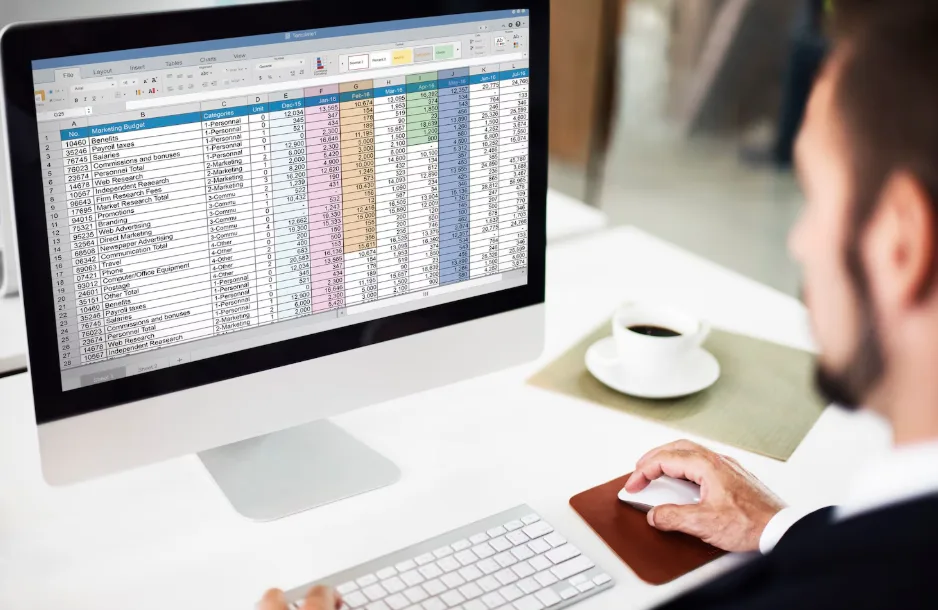
HR teams can manage their processes manually using spreadsheets or automate them with an HRIS. Many businesses, especially small ones, start by managing HR in spreadsheets because they see them as a free solution. While this approach may work well when the organization has only a few employees, HR tasks become more time-consuming and difficult to manage as the business grows. At some point, every growing business faces the same question: Is it time to switch to an HRIS?
Ready to try it yourself? Start your free trial of SteadyPoint HR. For more guides, visit the HR App blog.
Why many businesses start with spreadsheets
Many businesses start with spreadsheets because they offer a simple and familiar way to manage HR tasks.
- Spreadsheets are easy to create and use. With minimal experience, HR teams can create them to manage employee records, leave balances, and onboarding and offboarding processes. Spreadsheets are familiar to most employees and require little technical knowledge, making them easy to adopt.
- Spreadsheets are often available at little to no cost, making them an affordable option for businesses with limited budgets.
- Small businesses often have smaller HR teams or even a single HR person managing employee-related tasks. That makes spreadsheets seem like a practical solution.
However, while these benefits make spreadsheets a practical choice for small businesses, they become less effective as the company grows. If you're weighing whether software is worth it yet, start with whether small businesses really need an HR system.
When spreadsheets start holding your business back
At first, spreadsheets may seem like a reliable and cost-effective solution. However, as HR needs become more complex, their limitations start to appear.
As businesses grow, HR teams begin facing challenges that are difficult to manage with spreadsheets alone.
- HR processes including employee records, onboarding, offboarding, and leave management often require separate files to be managed. Over time, this makes information scattered across multiple files and hard to find.
- Manually updating employee records, payroll information, and other HR data increases the chance of human errors. This can lead to costly mistakes.
- Can you remember the last version of your file? Where was it saved? Was it shared by email, stored on a desktop, or downloaded somewhere else? Finding the latest version of a spreadsheet becomes difficult, and this increases the chance of editing and using old versions.
- HR tasks like leave tracking, onboarding, and document management take more time. The time spent on repetitive administrative tasks could instead be used for more strategic HR activities that support business growth.
- Extracting HR reports from multiple files can be difficult and time-consuming. It becomes even harder as employee numbers increase.
For a closer look at these trade-offs, see the hidden costs of manual HR processes.
How an HRIS makes HR easier
With the introduction of an HRIS, the daily activities of HR teams run more smoothly. It simplifies everyday HR tasks by providing a central, secure place for employee information, making data easier and faster to access whenever it's needed.
Onboarding and offboarding processes are also automated. Workflows can be configured within the system, allowing HR teams to automatically assign the required tasks to the relevant employees and keep every step organized.
In addition, HR management systems simplify leave and attendance management, giving HR teams the ability to track requests and approvals in real time from one place, without relying on emails or spreadsheets.
HR also relies heavily on reporting. Instead of compiling data from multiple files, HR teams can generate reports from a central database in just a few clicks.
By reducing repetitive administrative work, HR teams have more time to focus on strategic initiatives rather than routine tasks, helping the business become more efficient and better prepared for growth. Learn more in What Is an HRIS? Key Benefits and How to Choose the Right One.
HRIS vs. spreadsheets: a quick comparison
| Spreadsheets | HRIS |
|---|---|
| Higher risk of human errors | More accurate records |
| Difficult to maintain as teams grow | Designed for growing businesses |
| Time-consuming reporting | Instant reports |
| Information may be spread across files | Centralized employee database |
Conclusion: which one is right for your business?
As discussed above, spreadsheets are still a good option for very small businesses with simple HR needs. However, as the company grows, manual HR processes often become inefficient. This is where an HRIS can make a difference.
An HRIS helps centralize employee information, automate routine tasks, and gives HR teams more time to focus on supporting employees and business growth.
If you are looking for a solution to simplify your HR processes, SteadyPoint HRIS is here to help. The system offers flexible customization options and helps businesses manage HR processes more efficiently. If you'd like to learn more or have any questions, our team is happy to help. Contact us at sales@steadypoint.net.
Don't miss out — Start your free trial of SteadyPoint HR